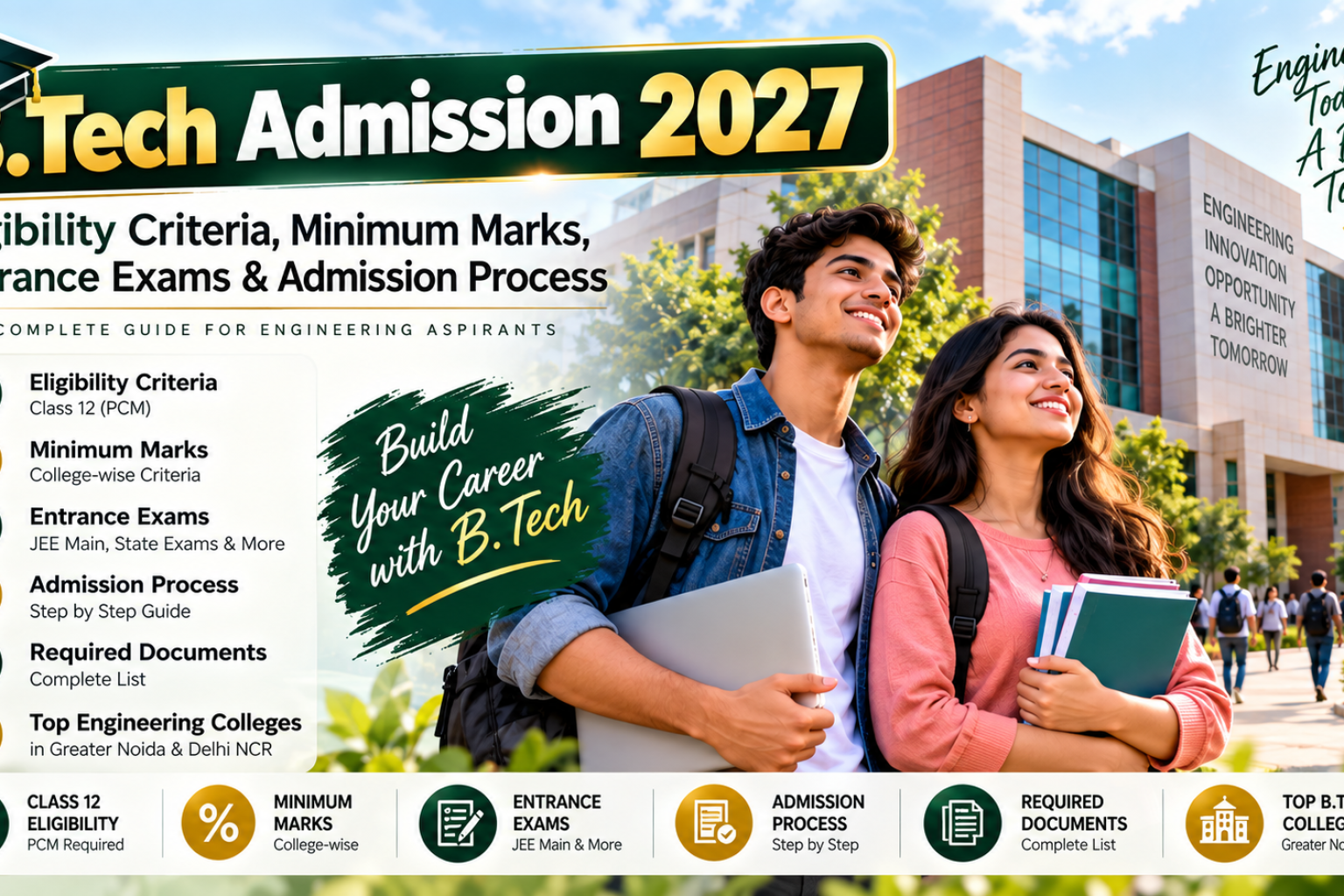
B.Tech Admission 2027: Eligibility Criteria, Minimum Marks, Entrance Exams & Admission Process
Are you planning to pursue B.Tech after Class 12? Understanding the eligibility criteria is the first step towards choosing the right engineering college. For the 2027–28 academic session, students should check the required subjects, minimum marks, entrance examination requirements and admission rules for their preferred colleges.
B.Tech, or Bachelor of Technology, is an undergraduate engineering degree that generally takes four years to complete. Students can explore specialisations such as Computer Science Engineering, Information Technology, Mechanical Engineering, Civil Engineering, Electrical Engineering and Electronics Engineering, depending on the institution.
In this guide, we explain the key eligibility requirements and how to prepare for B.Tech admission in 2027.
1. Basic Eligibility for B.Tech Admission 2027
Students generally need to complete Class 12 or an equivalent qualification from a recognised board. Engineering programmes commonly require Physics and Mathematics, along with other subjects specified by the institution and applicable admission rules.
Typical eligibility factors include:
- Completion of Class 12 or an equivalent qualification.
- Physics and Mathematics as required subjects.
- Chemistry, Computer Science or another permitted subject, depending on the applicable rules.
- Minimum qualifying marks as specified by the institution or counselling authority.
- An entrance examination or other selection process, where required.
Important: Exact eligibility requirements vary by institution, programme and admission route. Check the official 2027–28 admission notification before applying.
2. Minimum Marks Required for B.Tech
The minimum Class 12 marks required for B.Tech admission depend on the college, category and admission route.
Some institutions may specify an aggregate percentage in the qualifying examination, while others may apply subject-wise requirements or additional entrance examination conditions.
Before applying, confirm:
- Minimum aggregate marks in Class 12.
- Required marks in Physics and Mathematics.
- Category-based eligibility, if applicable.
- Whether improvement or compartment examination results are accepted.
- Whether entrance examination scores are required.
Do not assume that one percentage applies to every engineering college.
3. Is JEE Main Required for B.Tech Admission?
JEE Main is an important entrance examination for admission to several engineering institutions. However, it is not the only possible admission route for every B.Tech programme.
Depending on the institution and applicable regulations, admission may be based on:
- JEE Main scores.
- State-level counselling and entrance-related criteria.
- University or institution-specific entrance examinations.
- Other officially permitted selection routes.
Students applying to colleges in Uttar Pradesh should check the current counselling rules and the admission criteria of each institution.
4. Can You Get B.Tech Admission Without JEE Main?
Some private engineering colleges may offer admission through routes other than JEE Main, subject to their current rules, seat availability and applicable regulations.
If you are considering admission without JEE Main, check the following:
- Whether the college offers an alternative admission route.
- Whether you meet the Class 12 eligibility criteria.
- Whether any other entrance test or counselling process applies.
- Whether the programme and institution have the required approvals.
- Whether the admission offer and fee details are provided in writing.
Never assume that all private colleges offer direct admission without an entrance examination.
5. Popular B.Tech Specialisations
Students can explore different engineering specialisations according to their interests and career goals.
| Specialisation | Common areas of study |
|---|---|
| Computer Science Engineering | Programming, algorithms and software systems |
| Information Technology | IT systems, networks and software applications |
| Artificial Intelligence and Machine Learning | AI methods, data and machine learning |
| Mechanical Engineering | Machines, manufacturing and design |
| Civil Engineering | Infrastructure, structures and construction |
| Electrical Engineering | Electrical systems and power |
| Electronics and Communication Engineering | Electronic circuits and communication systems |
The availability of each branch varies by college and academic session.
6. Documents Required for B.Tech Admission
Keep the following documents ready, subject to the requirements of your selected institution:
- Class 10 marksheet and certificate.
- Class 12 marksheet and certificate, or applicable provisional results.
- Entrance examination scorecard, if required.
- Government-issued identity proof.
- Recent passport-size photographs.
- Transfer certificate or migration certificate, if required.
- Category or domicile certificate, where applicable.
- Counselling allotment letter, if applicable.
Always check the official document checklist before attending counselling or reporting to a college.
7. B.Tech Colleges in Greater Noida and Nearby Areas
Students exploring engineering colleges in Greater Noida and the surrounding Delhi NCR region can compare institutions, courses, eligibility, fees and admission procedures.
Here are some college profiles available on VidyaSaathi:
- GL Bajaj Institute of Technology and Management
- Greater Noida Institute of Technology (GNIOT)
- Galgotias College of Engineering and Technology
- IIMT College of Engineering
- Mangalmay Institute of Engineering and Technology
- Lloyd Institute of Engineering and Technology
- NIET
- KIET Group of Institutions
- ABES Engineering College
- Ajay Kumar Garg Engineering College (AKGEC)
These links are starting points for research, not a ranking. Confirm the current B.Tech programmes and eligibility directly with each institution.
Explore more options through the VidyaSaathi College Directory.
8. How to Apply for B.Tech Admission 2027
Follow these steps to prepare for admission:
- Select your preferred engineering branch.
- Shortlist colleges based on course availability, location and budget.
- Review each college's official eligibility criteria.
- Register for the required entrance examination or counselling process.
- Complete the application form and submit the required documents.
- Compare the official fee structure and available financial assistance.
- Complete counselling, verification and admission formalities as applicable.
Admission dates and procedures for 2027–28 may be announced at different times by individual colleges and authorities. Check their official websites for updates.
Frequently Asked Questions (FAQs)
What is the eligibility for B.Tech admission after Class 12?
Students generally need to pass Class 12 with the subjects required by their selected engineering programme, commonly including Physics and Mathematics. Minimum marks and other conditions vary.
Can students apply for B.Tech without JEE Main?
Some institutions may allow other admission routes. Students must check the college's current rules and any applicable counselling requirements.
How long is a B.Tech course?
A standard B.Tech undergraduate programme generally lasts four years.
Which B.Tech branch should I choose?
Choose a branch based on your interests, aptitude, preferred career path and the quality of the programme at the college you are considering.
Where can I compare engineering colleges in Greater Noida?
You can explore the VidyaSaathi College Directory and review individual college profiles to begin comparing options.
Conclusion
B.Tech admission eligibility for 2027 depends on your Class 12 subjects and marks, the selected engineering branch and the admission rules of the college or counselling authority. Before applying, verify the latest eligibility requirements, entrance examination criteria, documents and fee structure.
Start your college search on VidyaSaathi to explore engineering institutions in Greater Noida and across Delhi NCR.